
Ypsilanti Township Previous Residents by Era
No single record names everyone who lived at an address. For recent ownership, begin with the parcel and recorded-instrument trail. For people who may have occupied the property, add dated directory, newspaper, census, and archive evidence. The era table separates confirmed coverage from unverified online cutoffs, so an empty web search is not mistaken for an empty history.
| Source | Verified coverage | Where held | What it can establish |
|---|---|---|---|
| Township minutes, assessments, and election books | 1827-1923 overall; assessments 1832-1838; election books 1827-1860 | U-M Bentley | Early township administration and assessment/election context |
| County historical series | Tax assessments 1830-1871, 1900, 1920, and 1940 | Archives of Michigan guide | County-level tax and vital-index leads |
| YDL city directories | Dating to 1913 | Heritage Room | Names, occupations, and addresses as printed |
| YDL newspaper microfilm | 1864-2010 | Heritage Room | Notices, obituaries, social items, and local activity |
| Historical Society collections | Series dates vary | YHS archives and digital projects | Street-location, directory, tax, obituary, and photo leads |
| Released federal census | Subject to the 72-year public-release rule | Approved genealogy repositories | Dated household and address geography |
| Register of Deeds index | Online cutoff not located | County portal and office | Ownership instruments and legal-description trail |
| Building and inspection records | Start date not stated | County OnBase or township request | Work and inspection chronology keyed to an address |
Use the source that fits the question. A deed is stronger for a transfer of legal interest, while a directory or census is stronger for a dated printed household clue. A building permit may date work, but it does not establish every occupant. Keep the source type beside every name in a house-history timeline.
Start with a Ypsilanti Township Parcel
The Washtenaw County Parcel Lookup is the practical starting point for an address that exists today. Its form accepts parcel number, street name, street number, an optional street-number range, municipality, and taxpayer name. Choose Township Of Ypsilanti when the form offers a municipality selector, because it is distinct from City Of Ypsilanti. Street Name requires the name without a suffix, and Taxpayer Name uses a last-name-first instruction.
Read the returned material as three separate facts: the situs address is the physical parcel, the taxpayer or owner is the person or entity associated with the tax record, and the mailing address is where correspondence goes. A mailing address outside the township is not proof that the taxpayer lived at the property. The legal description and parcel number are the more stable bridge when a street name or number changes.
MapWashtenaw can then supply parcel geometry, street centerlines, aerials, and other layers. It is a reference viewer, not a legal survey or title determination, but it helps confirm that the address and parcel being traced are the same place.
Ypsilanti Township Previous Residents and Washtenaw Deeds
The Washtenaw County Register of Deeds keeps recorded deeds, mortgages, liens, plats, and other instruments. A backward chain begins with the present parcel and legal description, then moves from the current owner’s acquisition record to the prior seller, who becomes the earlier grantee to search. This traces property interests, not a complete roster of people who lived in the building.
Open the Register of Deeds public-record route before using the county index.
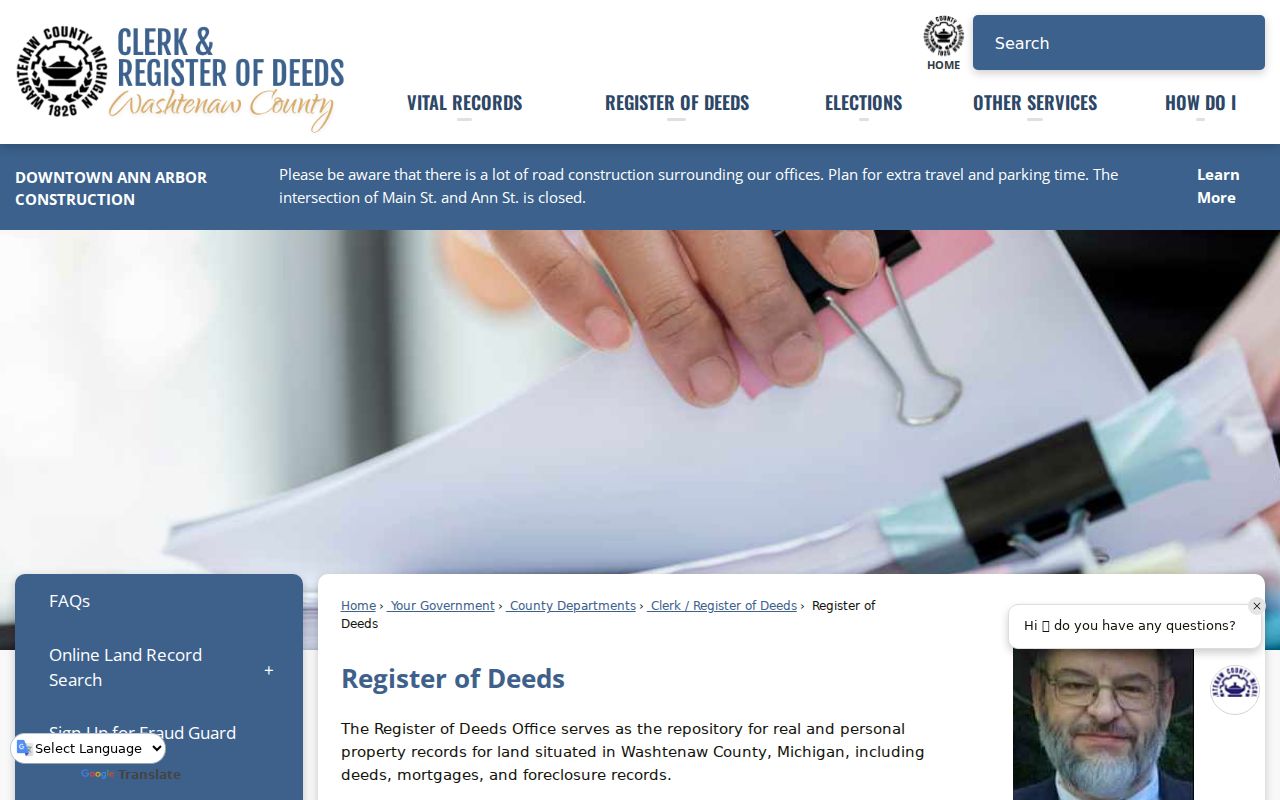
The county says recorded documents are public and provides an Online Land Record Search. Public searching is free, while purchasing copies now requires a login. The official disclaimer calls the index a finding aid, like a card catalogue, rather than the underlying document. Its inspected pages did not state an online start date, cutoff, live field list, image availability, or copy price.
- Record the current parcel number, situs address, and legal description from the parcel search.
- Find the current owner’s acquisition instrument in the Register of Deeds index.
- Read the instrument’s grantor and legal description, then preserve its number, date, and document type when shown.
- Search the prior seller as an earlier grantee and compare the legal description before repeating the process.
- When the online path ends, ask the office or a repository for the earlier instrument rather than inferring that none exists.
- Grantor
- The person or entity transferring a legal interest in a recorded instrument.
- Grantee
- The person or entity receiving that legal interest. In a backward deed search, a seller in one deed may be the grantee in an earlier deed.
- Chain of title
- The sequence of recorded transfers used to follow legal interests in the same property over time.
- Legal description
- The lot, block, subdivision, or metes-and-bounds wording that identifies land more reliably than an old street address.
Ypsilanti Township Previous Residents: Index Limits
The online index can change, and the Register of Deeds asks users to try spelling variations and as many criteria as possible. It is a guide to locating an instrument, not the document itself or a title opinion. Search alternate surnames, lot or subdivision wording, and date ranges when a direct name search stops. Keep mortgages, liens, releases, and assignments separate from conveyances so a secured party is not mislabeled as an owner or resident.
Online access is only one channel. Use the free public search for leads, a registered login when a purchased copy is needed, the Register of Deeds office for record assistance, and a precise county records request when the web route cannot expose the necessary material. State the address, legal description, name variants, document type, and date range. Michigan Freedom of Information Act requests under MCL 15.231 et seq. may be appropriate for public records held by the proper custodian, subject to applicable exemptions.
Note: A blank result may reflect spelling, indexing, a cutoff, or an unsupported search field, not proof of an absent deed.
Ypsilanti Township Previous Residents and Fraud Guard
Washtenaw Fraud Guard is a countywide, name-based alert service for recorded documents. It is not a title search and it does not prove that an alert concerns the property a person owns or once owned. The county warns that common names can produce false positives, so the document itself must be opened and reviewed before any conclusion is drawn.
For suspected fraudulent conveyances, preserve the alert and document details, then use the official county route. An alert can help someone watch a recorded-name trail, but it cannot replace the legal-description work required to connect an instrument to one Ypsilanti Township parcel.
Ypsilanti Township Previous Residents, Census, Directories
Ownership is only one layer of a house history. YDL city directories dating to 1913 can show names, occupations, and addresses as printed, while released census schedules can provide a dated household view. The historical collection details and entry-reading limits are available in the Ypsilanti Township city directory collections. Neither source proves title, and a directory listing cannot prove that every person in the household was recorded.
- Choose a verified directory edition and transcribe the name, address, page, and any printed relationship or occupation note.
- Compare the nearest available edition on each side of that year, preserving spelling and address changes.
- Match the period with a released census, taking care to read the city, township, and enumeration geography.
- Use newspaper notices, yearbooks, or Historical Society collections to test a move, death, school connection, or street reference.
- Leave an absence as a dated gap unless another source establishes why the listing changed.
Older names require particular care. Marriage, adoption, immigration, military service, or a move can change the form of a name. Pair a historical people source with a parcel or title source before attaching the person to the same property, and never treat a taxpayer mailing address as a complete household list.
Early Books for Ypsilanti Township Previous Residents
The U-M Bentley Ypsilanti Township finding aid is the strongest township-specific early record lead. It covers 1827-1923 and includes township minutes, highway commissioners’ material from 1827-1831, assessment rolls from 1832-1838, school-district records, and election books from 1827-1860. The collection is open for research at Bentley in Ann Arbor and is described as 12 volumes and 30 items, plus oversize and microfilm material.
These early books do not function as a modern address directory. They can, however, place a road, assessment name, school district, or township action in the period before the local directory shelf begins. The Washtenaw County finding aid adds county clerk, register, treasurer, poll-list, volunteer, and welfare series, but each item’s township relevance must be confirmed before it is treated as local to the address.
Ypsilanti Township Previous Residents in Newspapers
The YDL Heritage Room keeps local newspaper microfilm from 1864 through 2010, with a reader and printer. Search a name, address, institution, and date range in notices, social columns, marriage or death notices, and community reporting. YDL says it does not keep an active obituary file or send obituary copies, so the microfilm reader is the documented local access route.
The Ypsilanti Historical Society archives maintain obituary, cemetery, directory, street-location, tax-assessment, photograph, organization, and other collections. Its public archive hours are Tuesday through Saturday from 2 to 5, except national holidays, with additional time available by arrangement. For a probate endpoint, ask the court or records custodian using the decedent’s name, approximate death year, parcel or legal description, and case type. Exact local estate-file copy fees and historical cutoffs were not verified.
Note: A notice can supply a date or relationship clue, but it should not be presented as proof of a current address.
Ypsilanti Township Previous Residents and Address Gaps
Address continuity has several local traps. Postal Ypsilanti, the City of Ypsilanti, and Ypsilanti Township are different labels, so a mailing city alone cannot settle jurisdiction. Start each era with the printed directory label, then compare a plat, legal description, and modern parcel boundary. The research did not verify a township street-renumbering or renaming event, so no date should be assigned to an apparent address change without source support.
When a deed or directory trail seems to stop, search historic street names, spelling variants, subdivision and lot wording, and the legal description. The Library of Congress describes a February 1927 Sanborn item for the City of Ypsilanti with 27 sheets, but the item is not available online and city coverage cannot be assumed to extend to township roads. It is a context lead, not a township-wide address key.
Respectful Ypsilanti Township Previous Residents Research
Former-address research has a limited purpose: family and house history, estate or heir questions, and careful documentation of a property’s past. Public access does not erase privacy limits in vital, court, voter, address-confidentiality, or sealed records. Give each finding its source and date, and direct correction questions to the office that holds the record.
Michigan’s Address Confidentiality Program can provide a substitute address for protected participants. A conflicting or missing address may therefore have a lawful privacy explanation. The safe response is to leave protected information alone and rely on the responsible custodian for record-specific access rules.